
Abu Dhabi vs Dubai Corporate Retreats: How to Choose in 2026

Planners choosing between Abu Dhabi and Dubai for a corporate retreat usually get sold rather than told. Dubai's tourism machine is louder, Abu Dhabi's is newer, and the honest answer is that both emirates can run an excellent retreat. The differences are real, they are just narrower and more specific than either city's marketing suggests.
What Dubai genuinely offers
More hotel stock at every price point, more direct international flight connections, and an MICE industry that has been operating at scale for longer. If your group is flying in from a dozen different countries, Dubai's flight network makes logistics easier. If your delegates have already been to the UAE for a conference, they have most likely been to Dubai, and its skyline is genuinely spectacular but also genuinely familiar to a lot of frequent business travellers.
Dubai's desert offerings exist too, run by capable operators, generally positioned closer to the city with shorter transfer times, which suits a group with limited time on the ground.
What Abu Dhabi genuinely offers
A capital city built around culture and heritage rather than retail and skyline, a fast-growing MICE sector with dedicated infrastructure, and, on the entertainment side, Yas Island's cluster of attractions within one transfer of the desert. See our Abu Dhabi MICE overview for the conference and events infrastructure specifically.
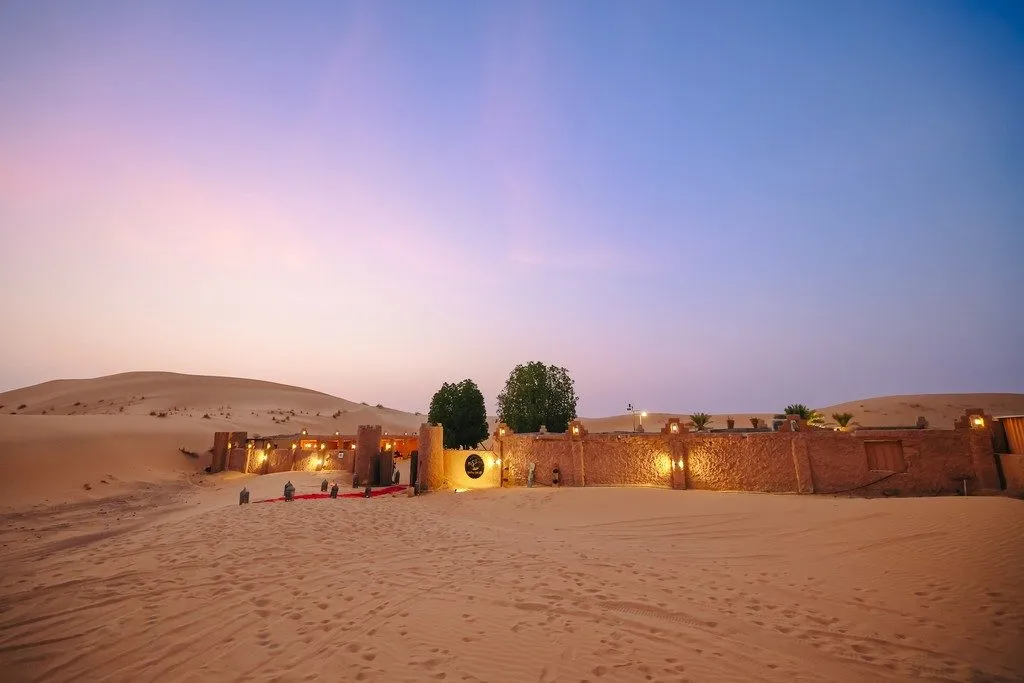
The Al Khatim desert sits roughly fifty minutes from the Corniche, far enough to feel like a genuine change of setting, close enough that it does not eat the whole day in transfers. It is also less photographed and less saturated in corporate content than the desert areas closest to Dubai, which matters if your imagery needs to look distinct from what a competitor posted last quarter.
Side by side
| Abu Dhabi (Al Khatim) | Dubai | |
|---|---|---|
| Flight access | Strong and growing | Extensive, most direct routes |
| Hotel stock | Solid across tiers | Widest range at every price point |
| Desert transfer time | Roughly 45-60 minutes | Varies, often shorter to nearest sites |
| Attraction pairing | Yas Island cluster, one transfer away | City-based attractions and retail |
| Familiarity to frequent visitors | Lower, feels newer | Higher, well documented |
| MICE positioning | Culture and capital-city framing | Scale and retail framing |
Meeting and conference infrastructure
If your retreat includes a formal conference component, both emirates have purpose-built venues capable of hosting it: Dubai's convention infrastructure is larger in raw capacity, reflecting its longer history as a global exhibition hub, while Abu Dhabi's has grown quickly and now covers most group sizes a corporate retreat needs without difficulty. For groups under a few hundred delegates, availability and rate are usually a bigger factor than raw capacity in either city, so compare specific venues rather than assuming one emirate wins on paper.
What actually makes the Al Khatim format distinct
Not the sand, which looks similar across the region to anyone who is not a specialist. It is the combination of a genuinely private site, a shorter and more predictable transfer than groups often expect, and an operator that has been running the same landscape for corporate groups since 2012 rather than adding desert evenings as a side line. Fourteen years and 500-plus events on one site means the logistics that go wrong elsewhere, staging points, sunset timing, wind contingencies, have mostly already been solved here.
See our fuller comparison at Abu Dhabi vs Dubai desert camps for the consumer-side version of this question, and desert safari: Abu Dhabi or Dubai for how the two compare for shorter excursion-style bookings.
A practical way to decide
If your group is arriving from many different cities on tight connections, weight Dubai's flight network more heavily. If the retreat's value proposition depends on feeling private, uncrowded and distinct from every other corporate desert photo your delegates have seen, Al Khatim earns its extra thirty minutes of transfer time. Many planners running a multi-day incentive programme solve this by basing the group in one emirate and running excursions into the other, which our incentive travel guide covers in more detail, alongside what makes a broader UAE programme work end to end. For the corporate-events side specifically, our Abu Dhabi corporate events page has the full service list.
It is also worth asking your own team a blunter question than most RFPs invite: has this group, or a previous cohort from the same client, already done the standard Dubai desert evening on an earlier trip? If so, repeating it, even at a different camp, tends to land as a rerun rather than a highlight. That is often the strongest single argument for shifting the retreat to Abu Dhabi even when the flight and hotel comparison otherwise favours Dubai.
FAQs
Is Abu Dhabi more expensive than Dubai for a corporate retreat?
Not inherently. Pricing depends far more on hotel category, group size and season than on the emirate itself. Desert programme costs are broadly comparable between the two.
Can we base our group in Dubai and still visit the Al Khatim desert?
Yes, though the transfer runs longer than from Abu Dhabi hotels, typically ninety minutes each way. Many groups instead base in Abu Dhabi for the days involving the desert.
Which emirate is better for a first-time UAE group?
Either works well. Dubai suits groups prioritising flight convenience and retail time; Abu Dhabi suits groups wanting a quieter, more capital-city and culture-led framing alongside the desert.
Does the choice affect availability in peak season?
Both emirates get busy November through March. Booking three to six months ahead matters more than which emirate you choose.
Related guides

Younus leads corporate and MICE delivery at Sparkling Sandset, including team-building programmes, incentive groups and DMC partnerships across Abu Dhabi and the wider UAE. He writes about the operational side of corporate events: venue selection, group logistics, facilitation and what changes when the guest list is a client's, not a family's.