
Planning a Desert Wedding Ceremony in Abu Dhabi
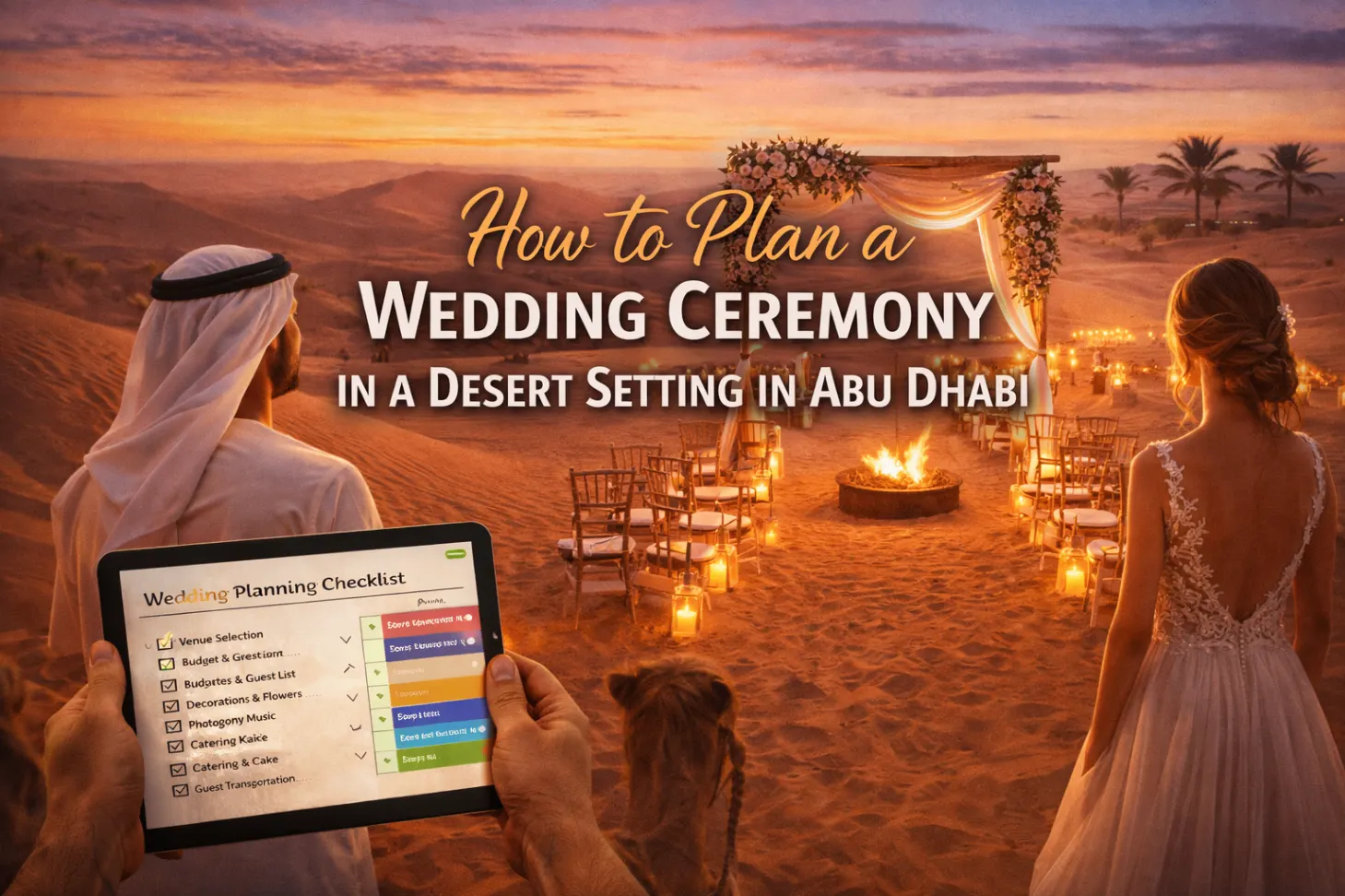
A desert ceremony asks for more planning than a hotel one, not because anything about it is difficult, but because a ballroom forgives improvisation and sand does not. There is no back-up room, the light will not wait, and the nearest shop is fifty minutes away.
Handled in the right order, it is one of the most straightforward weddings you can run. Here is that order.
Start with the date, then the hour
Choose the season first. November to February is comfortable at any hour and prices and books accordingly, with peak Saturdays going months ahead. October and late March are the value window. Summer weddings work as evening ceremonies but the whole agenda has to be built for the heat rather than against it. For the mechanics of timing a booking against that calendar, see our guide on how far in advance to book a desert event in Abu Dhabi.
Then fix the ceremony hour against sunset, because everything else hangs off it. We generally set vows to begin about forty minutes before sunset: the harsh light has gone, guests are seated in comfortable temperature, and the reception picks up as the sky turns.
Licensing and documentation
Sort this early, because it has the longest lead time and the least flexibility. What applies depends on the couple's nationalities, faiths and residency status, and the requirements differ for a Nikah, a church ceremony, a civil marriage and a symbolic ceremony with the legal marriage held elsewhere.
Many couples complete the legal marriage separately and treat the desert ceremony as the celebration, which removes a constraint. We advise on the route and coordinate with the relevant office, but the documentation itself sits with the couple and should be started months rather than weeks ahead.
Guest comfort is part of the design
This is where desert weddings are won or lost. Guests will be outdoors, in formal clothing, on sand, possibly for five hours.
- Firm, matted walkways from the drop-off to the ceremony, so heels are not a problem
- Shade over the seating for any daylight portion, and blankets available after dark in winter
- Water stations that are visible rather than tucked behind the bar
- A shaded rest majlis for older guests and for anyone with young children
- Serviced washrooms close enough to reach without a trek
- Transfers handled as part of the production, with a briefed convoy and a published return schedule
Tell guests what to expect in the invitation. "Flat or block heels recommended, and bring a wrap for the evening" prevents most of the discomfort before it happens.
The ceremony setup
An aisle, a focal structure, and seating. The focal point might be a mandap, a Nikah setup, a floral arch or simply an open frame against the dune line, and the last of these is often the strongest: the landscape is the backdrop and does not need competing with.
Two practical notes. Anything tall and fabric-based needs a wind plan, because desert wind is unpredictable at dusk and a collapsing arch mid-vow is a memorable outcome of the wrong kind. And sound needs a proper system with lapel microphones, not a single speaker, because open sand absorbs voices and the back row will hear nothing otherwise.
A workable run of day
Bridal party arrives early to a dedicated suite with proper mirrors and power. Guest convoy departs the city timed to arrive ninety minutes before the ceremony. Arrival hospitality, Arabic coffee and dates, guests seated fifteen minutes ahead. Ceremony at golden hour. Photographs in the light immediately afterwards while guests move to the reception for canapés and a welcome act. Dinner as the sky goes dark. Cultural programme and dancing. Convoy home on a published schedule, with a late option for those staying by the fire.
Permits and the boring necessities
Site permits, an amplified-sound notification with an agreed cut-off, drone and filming approvals if you want aerials, public liability cover and a medic on site. On our own camp the site permits are already held. Agree the sound cut-off before you finalise the timeline, not after, because moving a first dance is easy in planning and painful at 11pm.
FAQs
How many guests can a desert wedding hold?
Two to around a thousand. The layout, power plan and transfer schedule change shape above roughly two hundred and fifty, so be firm on numbers early.
What if it rains?
Rare, and usually brief. The practical impact is ground conditions rather than the ceremony. We check access two days out, hold an alternative site where ground is marginal, and keep tented cover for the full guest count.
Can we hold a Nikah in the desert?
Yes. The ceremony setup and the officiant are straightforward; the documentation is the part to start early.
Can guests stay overnight?
Yes. Overnight tents for the couple and a portion of the party work well, and a sunrise breakfast the next morning is a good close to the celebration.
Related guides

Tabassum founded Sparkling Sandset in 2012 and has run the Al Khatim camp through more than 500 private weddings, celebrations and cultural events since. She writes about the celebration and hospitality side of the business: weddings, birthdays, cultural programming and what it actually takes to host a private desert night well.