
What a Desert Wedding Actually Costs in Abu Dhabi (2026 Breakdown)
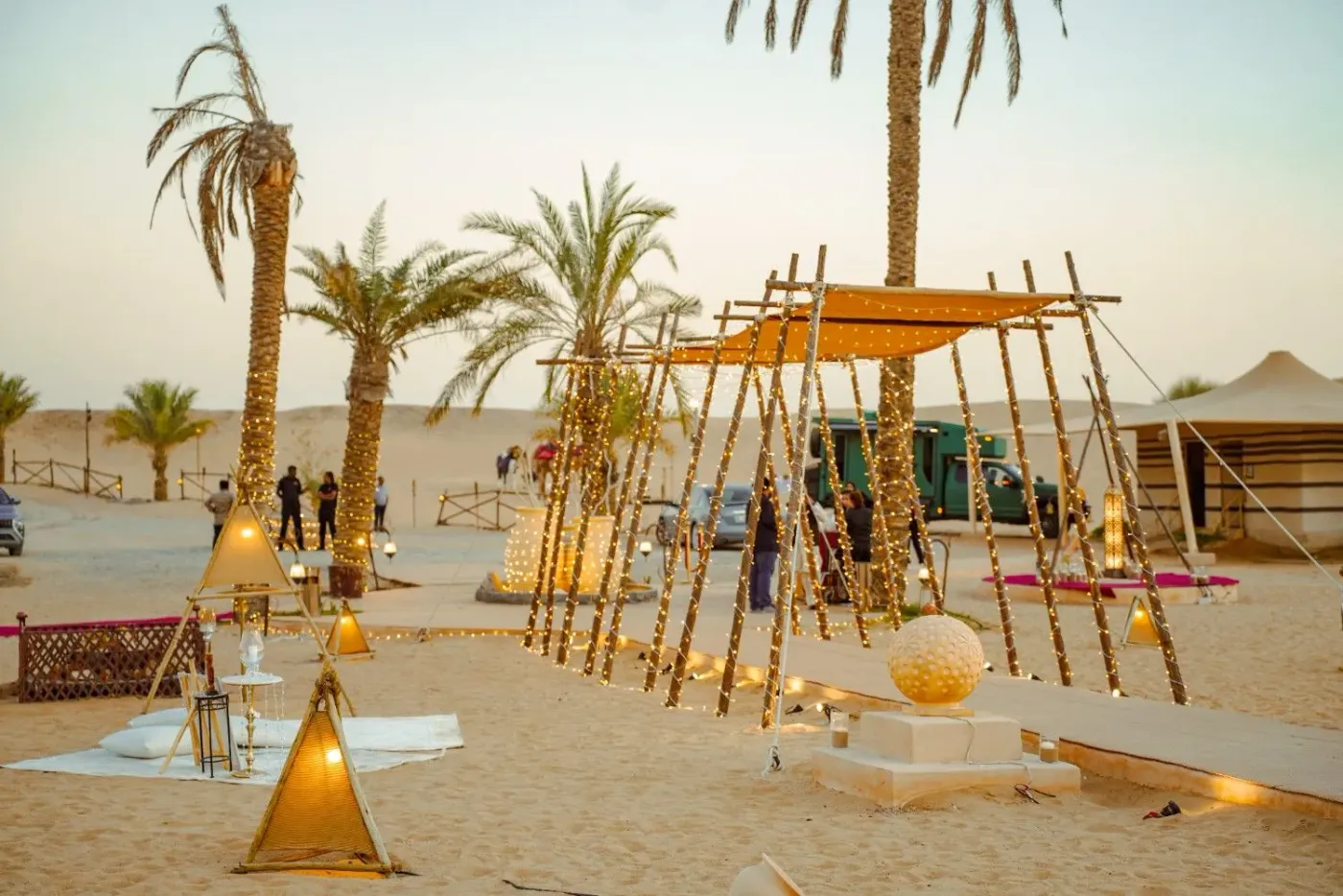
Almost every desert wedding enquiry we receive opens the same way: "We love the idea, but we have no idea what it costs." That is a fair question that the industry answers badly. Hotel ballrooms publish per-head packages. Desert venues rarely publish anything, which leaves couples guessing between a number they saw on a safari operator's website and a number they heard from a friend who booked a full production.
The two are not comparable. A shared safari seat and a private desert wedding are different products that happen to share a landscape. What follows is how the cost of a private desert wedding near Abu Dhabi is actually assembled, so you can build a realistic budget before you speak to anyone.
The one decision that sets your floor: private or shared
Before any line item matters, decide whether the site is yours for the day. A shared camp sells seats, you get a table at an operation running several groups, on their schedule, with their music and their menu. A private buyout means the camp takes one booking that day and the whole site, the timeline and the sound system are yours.
Every number below assumes a private buyout, because that is the only version that supports a ceremony. You cannot hold vows next to a walk-in dune-bashing rotation. The buyout is what converts a desert into a venue, and it is the single largest structural difference between a two-figure per-head safari ticket and a wedding budget.
Where the money actually goes
A desert wedding quote is not one number, it is roughly seven, and they scale differently. Understanding which ones grow with headcount and which are fixed is what lets you control the total.
1. Site and infrastructure (fixed, not per-head)
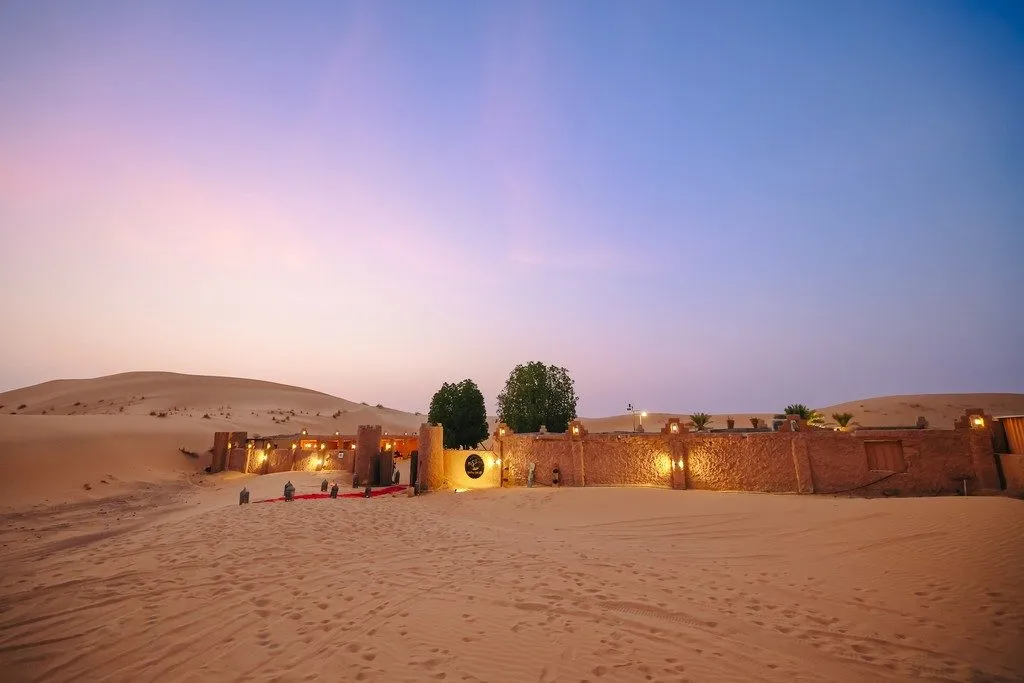
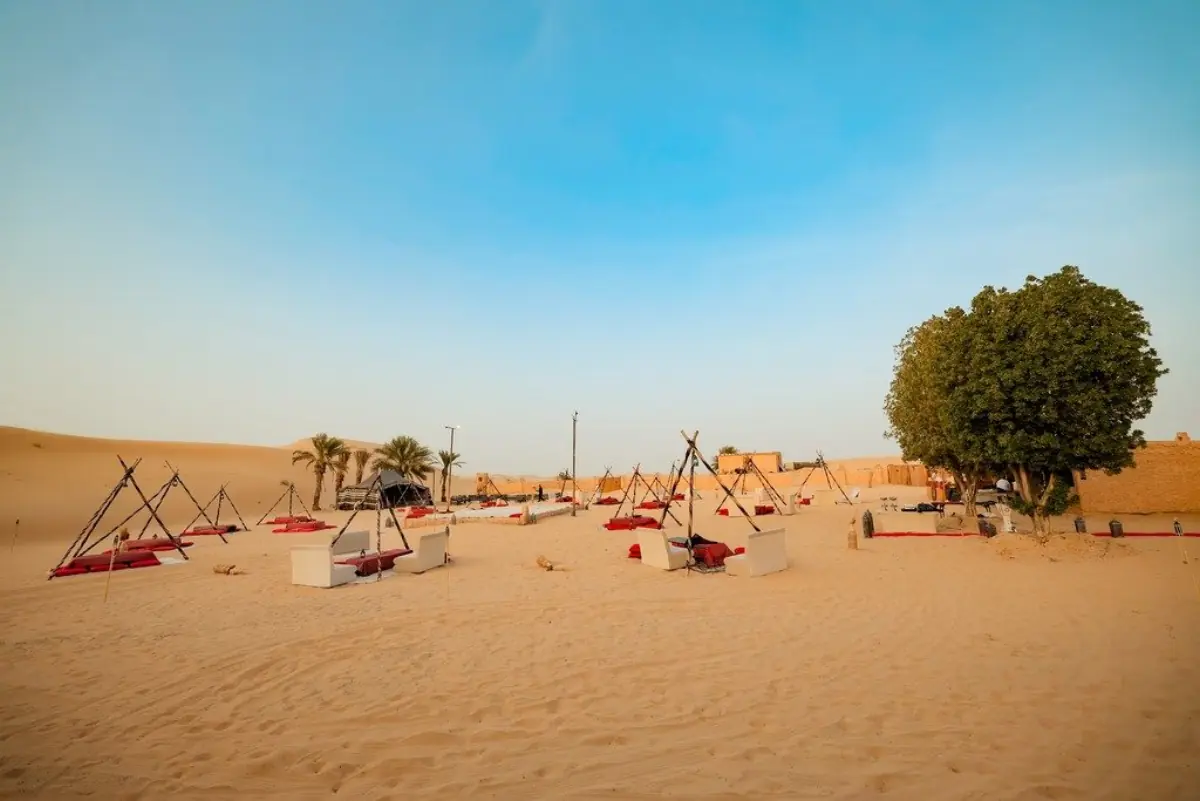
The buyout, the build and the strike. This covers the majlis and Bedouin tent structures, flooring, staging, generator power, lighting rigs, climate control where the season needs it, guest washrooms and the crew who put it all up and take it all down. This block barely moves between 80 guests and 200, you still need power, structures and a build crew. It is the reason very small desert weddings feel expensive per head and larger ones feel efficient.
2. Catering (per-head, and the biggest variable)
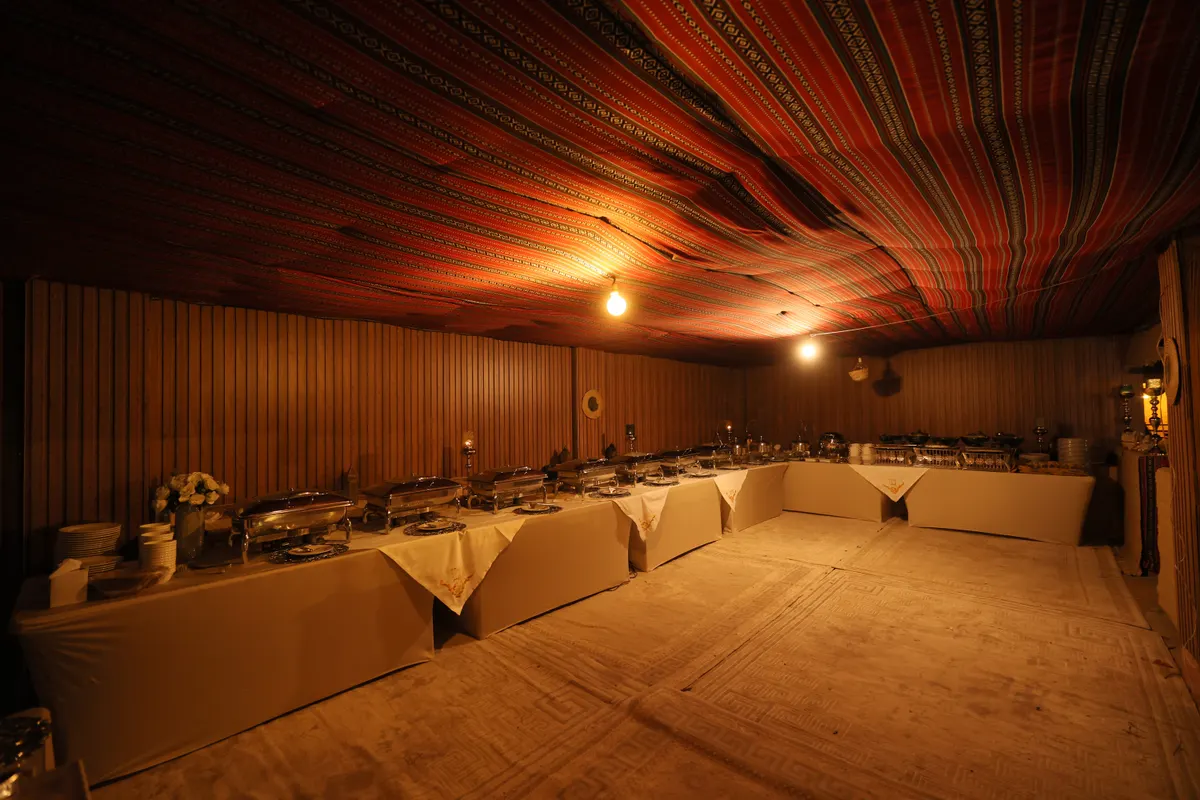
Menu format drives this more than guest count does. A grazing and live-station format, a served buffet with carving and shawarma points, and a plated multi-course dinner with synchronised service are three quite different operations, and the third needs roughly twice the service crew of the first. Dietary and halal compliance is standard rather than an add-on. If you need to move your budget meaningfully, the menu format is the lever with the most travel in it.
3. Styling and florals (fully elastic)
Ceremony aisle, mandap or Nikah setup, drapery, tablescapes, lighting design, signage. This is the most elastic line in the entire budget, the same guest list can be styled beautifully with restraint or built into a full set-design production. Imported blooms in July cost multiples of seasonal stems in February. This is where couples over-spend by accident, because each individual upgrade sounds small.
4. Entertainment and cultural programming
Ayyala and Yowla troupes, oud and qanun players, tanoura, fire performance, falconry displays, DJ or live band, sound and AV. Priced per act and per set length. A single welcome act at arrival plus a DJ for the reception sits at one end; a full cultural programme running across the evening sits at the other.
5. Photography, film and production
Desert shoots carry costs a ballroom does not, a longer call sheet because of the drive, golden-hour scheduling that fixes your timeline, and drone permits if you want aerials. Budget for the travel time, not just the shooting hours.
6. Guest transfers
The camp is about fifty minutes from central Abu Dhabi and ninety from Dubai. Coaches, 4x4 convoys for the final sand section, driver briefings and a return schedule. Guests who self-drive to a desert site in the dark get lost, so we treat transfers as part of the production rather than an optional extra.
7. Permits, insurance and safety cover
Site permits, municipality notifications for amplified sound and for any drone or filming activity, public liability cover and an on-site medic. Modest against the total, non-negotiable in practice, and the line most likely to be missing from a cheap quote.
The six things that move your number most
- Date. A Saturday in the peak November-to-March window prices differently from a weekday in May. Shifting midweek is the fastest saving available to a flexible couple.
- Season. Summer dates need cooling, more shade structure and evening-only timings, real infrastructure cost, not a surcharge.
- Guest count, but in steps. Costs jump at thresholds where you need another tent, another generator or another service brigade, not smoothly. Going from 140 to 160 can cost less than going from 160 to 180.
- Menu format. Covered above, and worth revisiting first when a budget needs to come down.
- Floral volume. Seasonal and locally sourced versus imported, in-season versus out.
- Multi-day scope. A Nikah, a Mehndi and a reception across two or three days is closer to three productions than one long one.
What a complete quote should contain
Ask for one document that itemises every block above, with build and strike shown separately from event-day service, and with permits named rather than bundled into a vague "production" line. If a quote cannot show you which costs are fixed and which are per-head, you cannot make informed trade-offs, and you will not be able to tell whether a later change order is fair.
Two questions worth asking anyone you brief: what happens to this number if we move midweek, and what happens if we add twenty guests. A supplier who can answer both immediately is quoting from a real cost model rather than a guess.
Deposits, timelines and the practical bits
For weddings we recommend confirming four to six weeks ahead as an absolute minimum, and considerably earlier for peak-season Saturdays, which go first. Menu tasting, floor plan sign-off and the final guest number typically land in the fortnight before the date. Permits are filed by the production office on a fixed schedule, so a very late booking limits what is achievable rather than simply costing more.
For a faster top-line figure by guest-count tier rather than this full line-by-line breakdown, our 2026 desert wedding cost guide gives the quick-answer version. And if you want the order things actually need to happen in, from permits to final numbers, the Abu Dhabi desert wedding checklist lays out the full timeline.
FAQs
Is a desert wedding cheaper than a hotel ballroom?
At small guest counts, usually not, you are paying to build a venue that a hotel already has. At mid-to-large counts the gap narrows considerably, and you get exclusivity that no ballroom can offer at any price. Compare like for like: a ballroom package rarely includes entertainment, styling to this level, or a private site.
Do you offer fixed per-head packages?
No, and we would be cautious of anyone who does for a private wedding. Fixed packages either assume a standard build that will not match your brief, or carry enough padding to cover every eventuality. We quote against the actual brief and itemise it.
How far in advance should we book?
Four to six weeks is workable. Peak-season Saturdays and any multi-day programme should be secured several months out. The constraint is rarely the site, it is the crew, the performers and the permit lead time.
What happens if it rains or a sandstorm is forecast?
We monitor conditions from several days out and hold a tented contingency plan for every booking. Genuine washouts are rare in the cooler months; the more common adjustment is moving the outdoor portion of the agenda under cover and shifting timings by an hour.
Related guides

Tabassum founded Sparkling Sandset in 2012 and has run the Al Khatim camp through more than 500 private weddings, celebrations and cultural events since. She writes about the celebration and hospitality side of the business: weddings, birthdays, cultural programming and what it actually takes to host a private desert night well.